Kangaroos Are Not Shoes: A Case Study in Corporate Transformation and Scholar Engagement
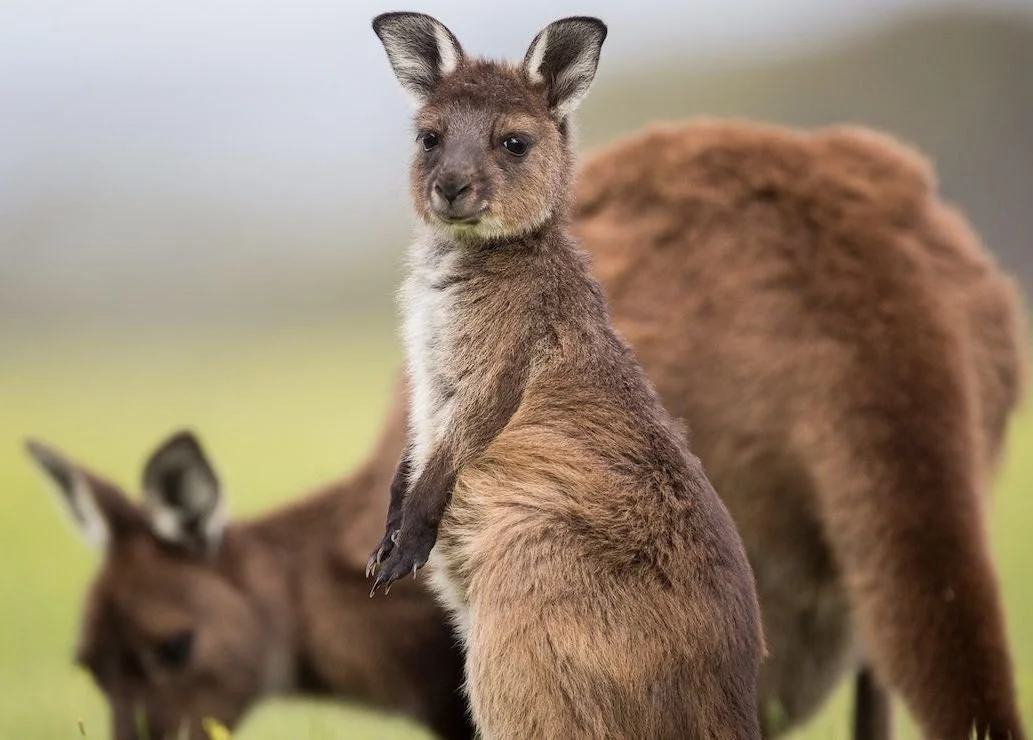
Scholars from our Network are engaged with our campaign to shutter the last of the commercial kangaroo killing industry. Their research helps anchor an upcoming kangaroo report—co-authored by our in-house scholars alongside scholars from the Network—that documents the collapse of the kangaroo skins trade and the declining kangaroo meat industry.
Dr. Dror Ben-Ami, a leading Australian wildlife ecologist who has been working for years to end the trade, has lent his expertise on the commercial kangaroo meat industry’s economics, food safety failures, and animal welfare considerations. Dr. Ben-Ami, who informed the report’s sections on the natural history and environmental impact of kangaroos, notes that the macropods are a native keystone species that have co-evolved with the Australian ecosystem for approximately 20 million years without human input. That deep evolutionary history stands in stark contrast to the industry that governs kangaroos today—an entirely artificial and recent imposition, measured not in geological time but in annual shooting quotas set by state governments.
Dr. Ben-Ami raises pointed environmental and ethical questions about whether this commercial bushmeat industry is justified or necessary at all. White-tailed deer and boars are commonly hunted in the northern hemisphere, he notes, but unlike kangaroos, they are not commercially exploited as a commodity to be mined and sold on the international market. Branding kangaroos as a “sustainable” resource subjects them to the free market rules of supply and demand, which he argues is a reckless approach for a government to take toward conserving wildlife. And having become an industry-level trade, he contends, the kangaroo industry should be held to the same minimal animal welfare standards required of other animal husbandry industries. On both environmental and welfare grounds, Dr. Ben-Ami concludes, the social license of the commercial kangaroo industry has failed. He adds that the absence of animal husbandry-level pathogenic regulation also subjects consumers of kangaroo products, and society at large, to an intensifying risk of zoonotic disease.
He explains that Australia should strive for coexistence with kangaroos rather than their commercial exploitation—shifting from an anthropocentric to an ecocentric approach to kangaroo management. Under this approach, Australian society can do better for kangaroos, farmers, and the environment alike: the occasional loss of income by farmers to kangaroos can be measured and addressed when it occurs, giving farmers commercial certainty, while the environment that has coevolved with kangaroos continues to do so without the crude intervention of the commercial kill. The negative impacts of livestock, cattle, sheep and goats, through soil compression and heavy grazing, and of non-native predators like foxes and cats on Australia’s grazing landscapes, far outweigh any perceived impact of kangaroos; failing to address those impacts, he warns, will always render kangaroo management efforts pointless.
Dr. Andrew Knight, a veterinary professor of animal welfare at Griffith University in Queensland, points to the significant food safety risk of the bushmeat: “As of 2026, there are more than 80 studies showing increased pathogenic hazards associated with raw meat pet diets. Concerns associated with the use of kangaroo meat could be even greater, because these animals have no pre-slaughter health screening, and because the hygiene standards applied within abattoirs cannot be achieved when animals are killed and processed in the field.”
Members of our in-house team of veterinary scholars, Dr. Thomas Pool and Dr. James Keen, also contributed their vast knowledge on the food safety issues associated with kangaroo bushmeat to the upcoming report. Their analysis draws on documented contamination data and investigations showing E. coli prevalence as high as 70% in minced kangaroo meat from South Australian processing plants, and up to 100% in fillet cuts and 89% in manufactured meat combining cuts from multiple carcasses. They also point to the detection of Coxiella burnetii, the bacterium that causes Q fever, in kangaroo meat, with strains genetically identical to those found in Australian human Q fever patients—evidence of a plausible transmission pathway. Compounding these risks, Drs. Pool and Keen note, is a stark surveillance gap—when more than 100,000 kangaroos died in a mass mortality event in 2016-17 from an unidentified disease, government agencies failed to investigate or collect samples to confirm the cause, even as kangaroo meat from the same period continued to enter domestic and export markets for human and pet consumption.
Dr. Svetlana Feigin, also part of the in-house scholar team and executive director of the All Life Institute, is one of the lead authors on the forthcoming report. Dr. Feigin earned her Ph.D. in psychology from the University of Auckland, New Zealand. She has provided a comprehensive overview of the kangaroo meat and skins industry, and with the academic contributions of other scholars, has highlighted the food safety, animal welfare, and environmental issues inherent in this waning enterprise.
Our previous, highly successful effort to close the driver of this industry, the kangaroo skins trade, culminated in the consequential campaign called Kangaroos Are Not Shoes.
Nowhere was the success of this campaign more visible than on the world stage of the summer 2026 FIFA World Cup. Over a billion soccer fans watched as elite athletes like Lionel Messi of Argentina, Kylian Mbappe of France, Erling Haaland of Norway, Harry Kane of England and other top-level soccer heroes put on football boots made of innovative fabrics, not kangaroo skins. Kangaroo skin boots were already in steep decline at the 2022 FIFA World Cup, but at the 2026 games, they had almost vanished.
Australia’s kangaroos were the real winners of the World Cup thanks to this campaign.
Since launching Kangaroos Are Not Shoes run by the Center for a Humane Economy and partners, we have secured commitments to end the use of kangaroo skins from every major athletic shoe manufacturer in the world. In 2025-2026, Adidas, ASICS and Umbro joined the likes of Nike, Puma, New Balance and Sokito to end the use of kangaroo skins. Mizuno has been slower but has stated its intention to stop. All these commitments came in six, short years, a testament to the campaign’s success.
A pivotal moment came when Center’s president, Wayne Pacelle, traveled to Nuremberg in 2025 to address Adidas’ leadership and shareholders at the company’s annual meeting. It was there that CEO Bjorn Gulden told Pacelle that Adidas had stopped sourcing kangaroos for shoes and was exiting production. A cascade of corporate commitments followed that has transformed the industry.
Prior to our campaign, these iconic athletic brands sold dozens of models of kangaroo skin boots to hundreds of millions of players in more than 190 countries. This drove the commercial killing of two million wild Australian kangaroos per year in their native habitat and the deaths of hundreds of thousands of joeys, often bludgeoned to death or left to starve when their mothers were killed for their skins.
With the kangaroo skins trade no longer propping up this industry, the kangaroo meat trade is now barely viable due to the loss of major markets but it still constitutes the largest slaughter of native wildlife on the planet and has been going on for decades.
Russia, once buying 70% of the meat, exited the market in the mid-2000’s due to repeated food safety contamination incidents. The United States imports just 0.6% of Australia’s exported bushmeat, while China refuses to import it at all due to animal welfare concerns.
The biggest market for kangaroo bush meat appears to be among some European Union nations, which accepts around 55% of the wild-caught bushmeat. Belgium is the largest buyer overall, importing over 30% of the meat from the commercial kill. Vietnam appears now to be a purchaser of meat from wild-shot kangaroos. In the kangaroos’ native Australia, the meat from these marsupials is supplied as a cheap ingredient for dogs in a desperate attempt to find a consumption strategy.
For members of the All Life Institute Scholars’ Network, the Kangaroos Are Not Shoes campaign offers a powerful lesson in transformative advocacy and science-based work. That work will have to continue in earnest to deal with the other commercial products from the night-time shoots of native wildlife across the continent of Australia.
Our report on the commercial kangaroo killing industry will be profiled in detail in our next newsletter.
Opportunities for engagement
If you or a colleague would like to support our efforts in this campaign, we would be grateful for any information or expertise you might be willing to share regarding the commercial kangaroo meat industry. Please email: sfeigin@centerforahumaneeconomy.org